Wednesday, December 17, 2014

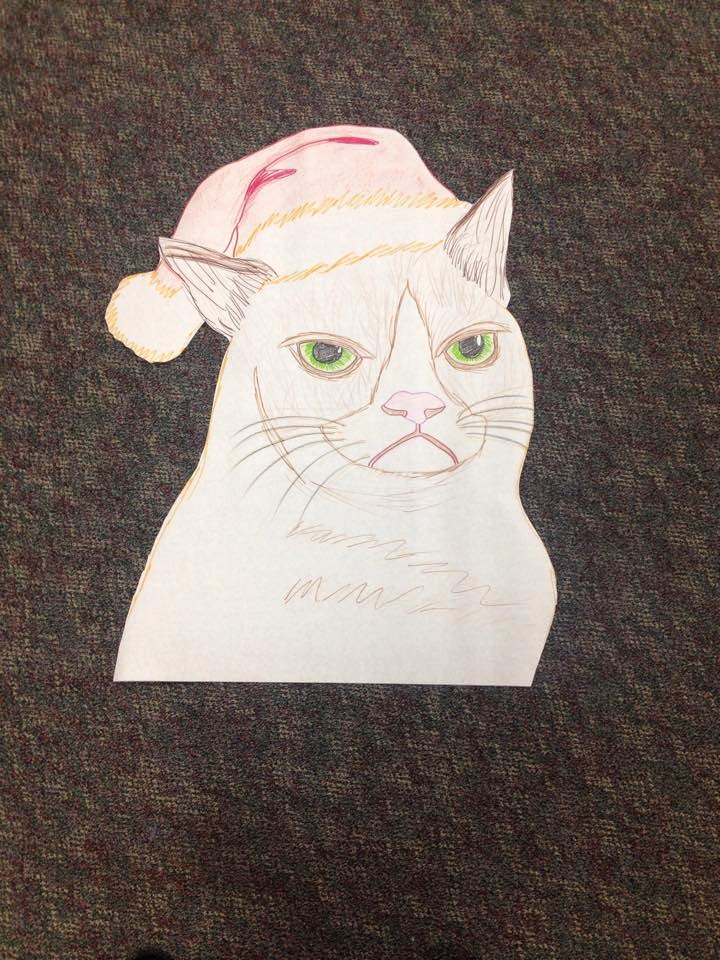
Grumpy Cat Christmas


I use memes often in my classroom, so I just couldn't resist having a Grumpy Cat Christmas this year. I had already created a DiatonNOc scale board, so when it was announced that we would be doing a Christmas Door Decorating contest, I knew exactly what I would do.


This door was crazy easy to create. I projected a picture of Grumpy Cat onto some butcher paper, traced it, went over it in marker, and colored it in. Add in some Fa La La’s and extra Christmas decorative stuff, and you've got a hilarious door!


The final product!

My favorite part is seeing the kids’ faces when they see it. Priceless! It’s even enough to make me feel a little less grumpy when kids lose their minds this close to break.

Friday, December 5, 2014

Nutcracker Scarf and Wand Dances


I love December: Nutcracker time! My kids love it, and so do I. Every grade has a least one Nutcracker class every year, but primary grades focus on it the most. We focus on the story of the ballet first, and talk about the music. I focus on instruments and dynamics. Then we move on to dancing with scarves and wands.

Dance #1: Trepak
Ah, the good old Russian Dance. I love this one because it tires kids out. Perfect for a day (or a string of days) with indoor recess! Students are given 2 scarves, though 1 scarf will still work if your scarves are in short supply.

This dance is very simple. This is a good dance to practice with hands before you throw in the whole body, since the scarves are basically doing the same thing as your feet. For the A, we jump while we have our scarves go up and down. Then we kick while doing a similar motion with the scarves. For the B, we pulse our hands to the beat while we make a big circle in the air with the scarves. First we go clockwise, then counter-clockwise. For the bridge, we freeze on the strong beats. Below is the visual I use with the kids.


Dance #2: Chinese Dance
I love all three of these dances, but this is the one that is most likely to make me laugh out loud. This song has two basic phrases, so there are two basic movements: Frozen and swirling the scarves downward until you have your hands at your sides (think penguin walk) and tip-toeing around the room.


Dance #3: Dance of the Sugar Plum Fairy
I love this song, and it is so iconic. But how do you get boys to dance to a “girly” song about a fairy? Tinsel wands, my friends. That’s how. I’m fairly sure they would be willing to walk around in sparkly pink toe shoes if it meant they got a tinsel wand. The wands are also easy to make: get a bunch of recorder cleaners that usually end up unused anyway, tie some long tinsel to the end, and cover it with tape. I covered quite a bit of mine, so students would know they shouldn't touch the wand above the tape line. I was worried at first that they wouldn't last long, but I still have wands from five years ago!

For this dance, students are put into two groups: the sneakers and the magical ones. The sneakers have scarves and the magical ones have tinsel wands. They take turns freezing while the other one gets to move.


When we are done, I always have kids fold their own scarves. Below is the echo song I use as we fold our scarves. (If you don’t want to have to use an echo song, you could always have them fold as you play March of the Soldiers instead.)

Tuesday, December 2, 2014

Using Memes in Music Class


This year, I am mentoring four new music teachers in my district. When asked what my favorite trick for teaching hard concepts was, my immediate reply was, “Memes!” That may seem strange, but I swear these things are magic. A few years ago, a class was really struggling with the concept of DS Al Coda. We tried stories. We made up a rhyme. We looked at visual examples, audio examples, visual AND audio examples… nothing stuck. I made a silly meme (Grumpy Cat, I believe), suddenly every kid got the check-in questions right, and I got a new tool in my toolbox.

 '
Bah humbug for the holidays! 

I love posting memes outside my door. If a class is early, the kids will find memes they like and talk about them. Some are rather silly, but others tie directly to concepts I will be teaching. I also went a little meme-crazy for my holiday board this year. No regrets. I highly encourage any opportunity for students to think about musical concepts, even if they are just giggling at an unfortunate T-rex as they walk by.

The first meme is mine, the second is from here. There is a PTP posting, too.


At the beginning of the year, I used memes to help explain the rules. Kids were more willing to deal with procedures when Spongebob and Grumpy Cat were involved. I have two rules: Respect and Participate. Both were explained using the memes above. 


Piano and Forte cat are always helpful!

I like to use memes to introduce concepts. It’s a good hook, and provides a visual aid you can bring up later if you need to. I have my favorite memes in a Pinterest board and use them all the time.

Are you're kids struggling with slur vs. tie? NOT ANYMORE.


Memes can also help to serve as review. I have review questions for my older kiddos as they come in. Posting a meme or a comic and asking the kids to explain the joke is an easy way to review a concept while getting students to use academic language. 


Yup. Spongebob memes galore. 

I have a Pinterest board of my favorite memes here, and use them constantly. I hope you can find one that will help a concept stick for your kids! Happy meme-ing!

Friday, November 21, 2014

SPLAT! A Review Game


5th grade example 

I love this game. I LOVE THIS GAME. Last week my school hosted about 20 admin from around the district. They were there to take a look at the school and check on how instruction was going. I had about 10 extra adults in my room during this activity. They tried to ask my kids questions about what they were doing, but the kids completely ignored them- that’s how focused they were on their task and this game. Have I mentioned that I love this game?

My 5th and 2nd graders have a big summative assessment in December. The test covers everything a wide variety of concepts, and with about an hour of instruction a week my kids need a lot of review to be ready. We do all kids of review activities the second half of November and December, but this is my favorite one by far.

2nd Grade Example

The game itself is pretty simple. There is a piece of butcher paper with 16 bugs drawn on it, and inside the bugs are musical terms. (You could really put whatever you want in the bug, though. Notes, instruments, you name it!) Students sit one on each side of the paper and have some kind of swatter- fly swatters if you have them; soft mallets work too if you don’t feel like blowing $30 at the dollar store for fly swatters. I have a bunch of soft mallets that came with drums, so I use those. You ask a question, students have three seconds of think time to find the answer, and when you say, “SPLAT!” they splat the answer on the board.


I always take a bit of time to just play the game first, with questions I create and project on the board. Once kids have a hang of it, we up the rigor by giving students the opportunity to create the questions. Kids love this, by the way. The prospect of tricking their classmates with a wicked hard question is very appealing to them. I don’t just let them loose, though. I give them 3 questions stems to choose from. They all require knowing the definition of the word, and range from simple plugging in the definition to creating a word problem that includes the definition in some form. Kids self-differentiate which question stem to use, and create 2-4 questions depending on the grade level. I did myself a big favor when I made these by making four words very clear to each person. Kids will naturally choose from those words when they create their questions. It cuts down on the arguments over who gets what word. 


Here are the question templates I used with my kids.

The only con to this game is the time it takes to make it. I have four kids to each poster, so creating enough for classes of 28 can be a pain, but it is SO WORTH IT! Plus, it's a good excuse to bring work home and work while I watch Doctor Who or Gilmore Girls. The cats love this game, too! 


The best part of working from home: DVR!


I hope your kids love this game as much as Noodle Cat does!

Monday, October 27, 2014

Lit Lesson: A Ghost Story


Halloween is around the corner, and that means it’s time to make some spooky music! This lesson provides an easy way to tie music to a book, and because the activity is so general you can shape it in several ways to fit in with what you are already learning.

One of my favorite Halloween lessons uses A Ghost Story by Bill Martin Jr with pictures by Eric Carle. Here is the book on Amazon. If you prefer to use Dark Dark Room, that is here. Since it doesn’t exclusively list Halloween, most of my students who don’t celebrate holidays also feel comfortable participating. I usually have something ready for them to do just in case, though.

The book is similar to the common story I remember reading as a kid, “A Dark Dark Room.” It is very formulaic: In a dark dark (noun) there was a dark dark (noun), and in that dark dark (noun) there was a dark dark (noun), so on and so forth. We eventually discover a ghost, who eventually discovers your pocket, and then… HE’S GOT YOU!

This book has so many possibilities! You can compare and contrast major and minor, talk about mood, focus on chords, focus on dynamics and crescendo in particular, really the options are endless.

For the older groups, we play an A minor chord on “dark dark” on tone bars. I allow them to choose what to play when, as long as it is A, C, or E. Students can choose to play the same thing each time, or change it up each time. (Yay for self-differentiation!) With the younger kids I dictate what they play, usually octave As or AC.

Once the kids have the basics down, we decide what we can do to make the book even spookier. My school uses thinking maps, so we use a bubble map at this point to brainstorm. Common choices the kids make include using chimes for the ghost, adding in my bigger drums later in the story, and adding a rainstorm with rain sticks and a thunder tube. I also like to have a few kids play Bb to add dissonance to the A minor chord.

Recording is a must for this book, students love hearing themselves play! I use a cheap plug-in microphone (similar one here) and audacity (free and awesome program, available here) to record class performances. We choose which take we like the best, and send it to their classroom teachers.


I hope you and your students have a blast with this ghost story!

Thursday, October 9, 2014

Reasons the Dollar Tree is My Friend (Part 1)

Dollar store loot!

I bet you just hate the dollar store, don’t you?

Nope, me neither.

There is a Dollar Tree right across the street from my school. In fact, it is on my way home. Every day as I drive by it, I have to make a conscious decision NOT to go to the dollar store. Needless to say, I go to the dollar store A LOT. It is a treasure trove for things that I can use in my classroom!


Pool Noodles

Why are pool noodles awesome? Simple: Steady Beat Light Sabers. They are very similar to the steady beat swords featured here. For mine, I decided to go all out and use silver duct tape and electrical tape to make them look like they came from a galaxy far, far away. I use my Light Sabers to teach steady beat to 1st graders. 3rd-5th graders use them as giant batons. Holding something so long in their hands helps them to use their wrists and not conduct like a crazy person.


Foam

The Dollar tree has rolls of foam! Rolls of it! They also have packets of foam. Similar packets or rolls of foam at Wal-Mart cost $5, and who knows what craft stores would charge. Why foam? Why, dear reader, because die-cut machines can cut foam. The foam is more durable than paper, and doesn’t require lamination! I went the paper-laminate-cut route for large quantities of small manipulatives once, and NEVER AGAIN. I learned my lesson! Using foam is so much easier. Students use these shapes to identify the form they hear, or create their own form.


Clinging Shelf Liner
I love this stuff more than I can tell you. A few years ago, my room made me wince with an ugly scarred table, ugly scratched brown file cabinets, and ugly large bright yellow storage boxes. Now those babies are covered, washi taped, and looking good! I used the same kind throughout the room to make it look unified.


Wash-tape

Speaking of washi tape, I found some at the dollar store. This is incredibly exciting to me, since most other places are trying to sell them for $3 a pop. The texture is a bit different, but it still comes off with no residue. Count me in! I’m using washi tape to organize my orffatorium. Each instrument has tape, and the matching mallets have the same kind of tape. Using different colors and patterns also allows me to put kids in groups more interesting than woods and metals.

Stay tuned for another post on awesome things from the dollar store and how I use them!


BONUS: I love these matched cards from the dollar store so much, I wrote an entire post about them. 

Monday, September 22, 2014

Manipulative Monday: Review Cards

One of the battles I constantly fight as a music teacher is forgetfulness. When you see your kids only once or twice a week, it is a battle that will never stop. I don’t want to waste time going over already learned concepts every other second, so we regularly review the concepts already covered.

Every day with intermediate grades, I have two or three review questions on the board so students have a task to focus on as soon as they are in the room. We go over them very quickly, and this does help them to remember concepts. Sometimes, however, students more than one or two questions to make sure they stay on top of previously taught concepts. This is even more true with grades that are about to take summative semester tests. Partner review cards are a great way to help review and keep students engaged.

Can I tell you how much I love the dollar store? I LOVE IT A LOT. There are so many good things you can use as manipulatives, and for a lot less than official manipulatives online or at teacher stores. This summer, I found these beauties at Dollar Tree and stocked up, knowing they would come in handy. They come in packs of 24, so I picked up several of each to be ready for the larger classes.


The game is simple. Students have a card that is either a concept or a definition/example. Students get a card and silently move (I use a musical timer) to find the person who has the accompanying card. For first and second graders, I let them whisper to help students who may not be to the point of silently reading yet. Once students find their partner, they talk for a few moments to make sure they can justify why they think the two cards go together. We check a few groups as a class, and then the students have 10 seconds to trade cards with someone who was not their partner. This sets us up for another round.


Here is a second grade example.

I like this game because it gets kids up and moving, gives them a chance to talk with several partners, and really reinforces previously learned knowledge. I focus on getting students to justify why they chose the answer, really making them think about their reasoning. My school is also focusing on accountable talk, and this activity is a good opportunity for students to practice those skills. This is a great review for any definition-heavy subject as well. I've found this game much more effective than more traditional reviews with paper and pencil.

Have fun with this game, I hope your kiddos love it as much as mine do!