Monday, February 23, 2015

Classroom Management: General Tips


I am mentoring several new music teachers in my district this year. The biggest concern of every single one? Classroom management. I was right there with them my first year; if you are a veteran teacher who had amazing classroom management right off the bat, then please let me know who you are… so I can grovel at your marvelous feet.

Management is nearly impossible to master as a student; you can learn Fred Jones until you are blue in the face and yes reading can help, but it just can’t be mastered until you have experience. A lot of it. But what do you do until then? What do you do when 19 2nd graders are doing their absolute best, but 6 have checked out due to the one who is hiding behind your instrument storage, singing “Twinkle Twinkle” as loud as they can because “half notes are evil and I won’t learn about the devil in school”? (Yes, that really happened.)

This was me, the next morning.

We have all been there. While it’s hard to have ironclad “you must do these things” in management because every teaching style differs, here are some general tips that I’ve found helpful in establishing my classroom.

1.) Don’t take it personally.
If you’re brand new or even new to a school, it can take time for students to trust you. This is especially true for your at-risk students. At first, students are learning much more about you and what your limits are than your actual subject. They will push, and sometimes they will say terrible things that they don’t mean. It doesn’t mean the kid is bad. It doesn’t mean you are bad. Most likely, you’re both just adjusting. Clear rules help this adjustment. That way, when that 4th grader is using a mallet to annoy their buddy, you can calmly point out that they made the choice to break rule whatever, and can now sit out. Then, it isn’t personal for them either; it’s simple cause and effect.

2.) Stay calm.
For some students, getting a rise out of the teacher = VICTORY. Use extreme volumes only in extreme situations. This can also apply to getting flustered. If I make a mistake? Hurray, I am officially human and not an alien. I always acknowledge the mistake quickly and move on. Do I still get flustered? You bet. I just don’t make a huge deal out of it. The goal here isn’t for it to never ever happen, the goal is for it to not be a part of the culture of your classroom.

3.) Find the positive.
This should be easy, because if you weren’t freaking awesome you wouldn’t be teaching. But the truth is, our culture is currently quite focused on rooting out the “bad apples” and education can be very overwhelming. It is easy for teaching to become an oppressively negative experience. I absolutely, completely guarantee: EVERY SINGLE LESSON you teach every single day has at least 3 things about it that were good. Maybe they were small, but they were there. Find a few of them. Sure, you need it so you don’t go insane, but it is also helpful to know what is working so you can build on your strengths. If you can’t find them, call in reinforcements from a colleague or video-tape yourself teaching your best management class.

4.) Self-evaluate

“I’ve come to a frightening conclusion that I am the decisive element in the classroom. It’s my personal approach that creates the climate. It’s my daily mood that makes the weather. As a teacher, I possess a tremendous power to make a child’s life miserable or joyous. I can be a tool of torture or an instrument of inspiration. I can humiliate or heal. In all situations, it is my response that decides whether a crisis will be escalated or de-escalated and a child humanized or dehumanized.”
-Haim G. Ginott

Here comes the tough love, folks: if you are having classroom management issues, your kids are only half the problem. Hear me on this though: That does not, ABSOLUTELY DOES NOT mean you are a bad teacher. Do you expect kids to get a concept perfectly 5 minutes into a lesson? Probably not. Don’t expect the same thing of yourself, because you will make mistakes and that is OK. However, for most lessons you will have to take an objective look at the things you do and figure out what isn’t working so you can improve. Often, it is a behavior that leads to the escalation of a negative situation. What were you doing before a normal situation got bad? If you aren’t sure, bring in a video camera to your toughest class and tape yourself. That can also help you spot escalating voice inflections, like sarcasm.

5.) Be the positive
Kids are incredibly sensitive about the “s” word: stupid. I have kids who aren’t great at one subject, and become absolutely convinced they are stupid and terrible at school (despite being geniuses in other subjects.) Humans tend to focus on the negative, and one of the best parts of teaching music is our ability to find that one thing kids are great at and highlight it until you can see that sucker from space. We can’t do that until we establish our classroom as a place of mutual respect. Using positive language like “please walk” instead of “Oh God DON’T RUN ARGH” (I’ve totally caught myself saying that exact sentence before) helps you establish a safe space where kids can fail but continue on to succeed. I also use positive reinforcement whenever possible. Word to the wise: stickers are magic, and Dollar Tree has foam music-themed ones.

6.) Balance novelty with procedure, and insanity with structure.
I know I’m getting through to a kid when they laugh and tell me I’m crazy. Because guess what? Kids pay attention to the crazy lady. (Or crazy dude. This tactic works well for anybody willing to be nuts.) They want to see what I’ll do next, so they give me the benefit of the doubt. One of my best engagement strategies is being an unpredictable crazy lady. My students no longer blink twice when I show up in a wig and frock coat to be their substitute Herr Mozart, and even my jaded 5th graders put up with my antics because they know something good is coming. They also know exactly what my rules are, exactly where my limits are, and exactly what the consequences are for each action, both good and bad.

7.) Be consistent
Yes, I know that one first grader is stinking cute. But if they break a rule, they need to have consequences. That isn’t to say you shouldn’t differentiate; several of my kids have deals with me for specific behaviors I am looking for, or a hand-sign for when they need a chance to cool-off. As a whole, though, be clear about your expectations and stick to your guns. If playing out of turn on drums, recorders, or tone bars means two minutes of silence in your class, then you need stick to the that consequence. Only set consequences you are willing to follow through with. Do this with positive actions as well. For keeping track, I have individual systems as well as a class-wide system using Class Dojo.

8.) Get them moving
Music teachers have an advantage with this, because so much of what we teach is naturally kinesthetic. But even if you are doing a lesson focusing on theory, find a way to get kids up and moving. If that means they jump while reciting a definition, cool. Braindance at the beginning of the lesson? Word. But you don’t want kindies to sit criss-cross-applesauce for 40 minutes if you want to keep your sanity. (Let’s be real, it’s probably hanging by a thread anyway.) If you have longer classes, consider taking quick one-minute brain breaks. I also let students earn dance breaks if they finish what they need to get done in a lesson. Go Noodle is a great resource for this.


I hope these tips will help you. I plan on going into more detail with certain things, like procedures, soon. Have a great day!

Friday, February 20, 2015

Lit Lesson: The Jigaree


I completely lucked out with this book! I found it in a “free” pile from the library and it is PERFECT for blending rhythm reading and locomotor movements. I use it with quarter notes, eighth notes, and quarter rests.

The book is a “read-together book” from the 80’s and is very simple. The format of the book is,

I can see a jigaree. 
It is (locomotor motion)ing after me.
(LM motion)ing here, (LM motion)ing there, 
jigarees (locomotor motion) everywhere.

The book can be found here. It is out of print, but there are used copies available. If that isn’t your cup of tea, you could easily use the chant with a different animal.

First, we read the book. Then we go through the locomotor motions listed in the book. Next, we add our own locomotor motions. I have a movement wall that they can use as a starting point.

Once we have the movement portion of the game down, instruments are added in. I have a big set of rhythm cards that each have four beats of rhythm. We take one, students have a short amount of time to figure the rhythm out, and then we play the rhythm on instruments. For this activity I use tubanos or frame drums, but we do similar activities on many kinds of instruments and body percussion. Kids are used to rhythm-reading before we add in the book and movement. Through one activity or another, students have read each rhythm card before.

Once we are ready to put everything together, I split up the class. I usually have 5-7 on instruments, one conductor, and everyone else moving. Most of the instrument group are on tubanos, but one will be on finger cymbals.

During the chant portion of the book, the student conductor shows a rhythm card to the kids on drums. Students on tubanos have time during the chant to practice the rhythm. After the chant, the students on tubanos play the rhythm they have been assigned until one student, on the finger cymbals, signals them to stop. The movers also have to stop when they hear the finger cymbals.

After a round, the conductor and one of the tubano students switch groups and are replaced by new students. This is a great opportunity for small group assessment, both for movement and rhythm reading.

Monday, February 9, 2015

What's in a Book?


I recently attended my state's music education conference, which was fantastic. I noticed a lot of good clinics on children's books, and was talking about with some teachers from my district. I happen to love it and use books as often as possible, but I know some teachers are wary of using books in the music room. One concern I heard about books was how to choose them, and what you should look for. I definitely struggled with this at first, but thanks to several hours in thrift stores and the library I know what I want in a book. Here's my list:

1.) Type of activity
There are as many types of books in the music room as there are activities. Books to accompany major works or composers, books that lead the kids to instruments, books that lead to singing or speaking, and books that lead to movement are some of the major categories I keep in mind as I thumb through stacks at the thrift store or library.

2.)  Reading Level
Think about it: Even with fourth or fifth graders, every word in the book will need to be read out loud, or summarized quickly. So keep it simple. I keep my books at a primary reading level; the older kids won’t mind as long as the lesson is engaging. If they are taking some convincing, have them create a recording for the kindergarteners so the intended audience is younger.

3.) Repeated Structures and Refrains
Simple structures and refrains allow students multiple opportunities to move or make sound, and allow them to know what’s coming next without constant reminders. Rhyming can also help, though it isn't always necessary.

4.) Onomatopoeia
Sound effects are very easy to transfer to instruments. This is especially effective for K-1. I like to have students explore the sound effects and then choose which instrument fits, which increases rigor. (Plus, the students think it is very fun!)

5.) Vocal Exploration Opportunities
You pretty much can’t go wrong with a roller coaster. Animal sounds are also good opportunities to explore.

6.) Connection to common or folk songs
If you find a book about a lost cat, it is simple to connect it to “Ding Dong Digga Digga Dong”.  A star book can be connected to “Twinkle Twinkle,” and the list goes on and on.

7.) Lots of verbs
This can lead to movement activities, or can lead to making noises that represent each movement on instruments or with sound effects.

8.) Abstract books without words, or books that focus on a line or simple shape
                The possibilities are endless! 

9.) Common Themes
There are some themes that do a good job of lending themselves to onomatopoeia and folk songs. They include (but are certainly not limited to):
·         Farm Animals
·         Stars and Moon
·         Trucks, Cars, and Trains
·         Cats and Dogs
·         Rain
·         Sleep, Lullaby
·         Halloween
·         Opposites
·         Eric Carle

Complete Lit Lessons
                Here are books I have posted about, complete with lesson ideas. 
·        Ghost Story, by Bill Martin Jr. (lesson here)
·        Listen to the Rain, by Bill Martin (Lesson here)
·        Blue Hat, Green Hat, by Sandra Boynton (Lesson Here)
·        The Jigaree (Lesson here)
·         Going on a Lion Hunt, David Axtel (lesson here)
·         Wide Mouthed Frog, Keith Faulkner (lesson here)
·         Tikki Tikki Tembo, Arlene Mosel (lesson here)

Starter List
                Here are some additional books I've had success with in my classroom:
·        Muncha Muncha Muncha, Candace Fleming (Instruments, gardening songs)
·         From Head to Toe, Eric Carle (movement)
·         Blue Hat, Green Hat, Sandra Boynton (instruments, pattern, quarter/eighth notes)
·         Mortimer, Robert Munsch (Instruments, up/down patterns, np perc., words for song in book)
·         How to Speak Moo, Deborah Fajerman (Vocal Exploration and head voice)
·         The Squiggle, Carole Lexa Schaefer (Movement)
·         Tanka Tanka Skunk, Steve Webb (Drumming, Quarter/eighth notes)
·         The Jigaree, Joy Cowley (Movement)
·         The Wide Mouthed Frog, Keith Faulkner, Jonathan Lamber (instruments)
·         Grump Groan Growl, Chris Raschka (Sound effects, instruments)
·         Bear Snores On and Bear Feels Scared, Karma Wilson (Instruments, sound effects, dynamics)
·         Fortunately, Unfortunately, Michael Foreman (Vocal exploration, instruments
·         Polar Bear, Polar Bear, What do you hear?/Brown Bear, What do you See? Eric Carle (Singing)
·         Down By the Station, Will Hillenbrand (Folk Song, Singing)
·         Hush! Minfong Ho (Singing, lullaby, instruments)
·         Where the Wild Things Are, Maurice Sendak (instruments, dynamics, singing)
·         A Frog in the Bog, Karma Wilson (Instruments, dynamics)
·         Rain Drop Splash, Alvin Tresselt (Instuments, Movements, dynamics)

·         Cat Skidoo, Bethany Roberts (instruments, movement)

Monday, January 12, 2015

Manipulative Monday: Rhythm Round Up


My first graders just started their rhythm unit, and it really is one of my favorite times of the year. There are just so many good ideas for teaching rhythm! Below are a few of my favorites. If you wish, most of these would be easy to turn into stations.


Chair Rhythm
An oldie but a goodie. I got this from Jim Solomon, but this is so common there must be more than one source. You set up four chairs, and inform the kids that each person is a sound and each chair is a beat. I have them count the number of heads; one head is a tah (its real name is quarter note) and so on. This makes note heads easier to explain later. We start with the representative notation, and I follow along with stick figures on the smart board. Once it is time to introduce the musical notation, I simple fill in a stick figure’s head and draw the note. The “aha” moment they get is pretty fantastic to watch. My district teaches rhythm in a “# of sounds, # of beats” format, so teaching them to count note heads to know the number of sounds is very helpful. I use chair notation to introduce rhythm. I usually bring it back for any new rhythm as well, or whenever students get stumped on a rhythm.
Introducing musical notation


Mini-Notation Sort
When I moved into my current classroom, I found stacks and stacks of empty CD cases. I was tempted to toss them all, but decided to keep them just in case. Boy, am I glad I did! It turns out that when you take a sharpie and add a line down the middle of the case, you get a perfect four-section sorter. (You could do this with the typical square cases as well, just pop out the black cd-holder.)

I printed off a quarter sheet with each of the rhythms as well as their definitions, then printed off mini notation cards. Kids take their cards and sort them into the correct term and definition. This is a great check for understanding if your objective is identification.


Pipe Cleaner Notation
When my art teacher graciously donated a box of short pipe cleaners, I knew I had struck manipulative gold. These things are useful in general, but perhaps my favorite use of them so far is as a way for student to get to know the notation of rhythms. I have students first use a set of mini-notation to set up a rhythm, so there is an exemplar close at hand. Then students use the pipe cleaners to create each rhythm. Kids can get a bit “creative” with them at first, but it’s fun and engaging.


Foam Heart Notation
My first year teaching, I went through the trouble of laminating a ridiculous number of hearts for steady beat and rhythm teaching. It was a pain, and my school is VERY protective of the laminator and encourages us to use it as little as possible (preferably never.) Oh, if only I knew then what I know now! Instead of feeling guilty for a large laminating job and burning through your paper supply, pick up some foam from the dollar store. It works with the die-cut machine, and lasts as long as laminated paper. You can also easily find pre-cut shapes at hobby stores. These hearts were free (yay!) so I use them constantly, but it could easily be a different shape if you wish.

I use the big hearts to represent the beat, and the little hearts to represent the number of sounds. Alternating the colors of the big hearts makes it easy to add in the concept of strong and weak beats later.


Chip and Stick Rhythm

This also uses representative notation, but uses a square for each beat and a chip or stick for each sound. You could use just the bingo chips, but I throw in popsicle sticks as well for the longer rhythms like half and whole notes.


Rhythm Dice
I love these things! They have so many uses. Students could identify the sounds, beats, or sound of note they roll. These dice could also be used to create a rhythm, or inspire a game of notation-search using a piece of sheet music. 

Wednesday, December 17, 2014

Grumpy Cat Christmas


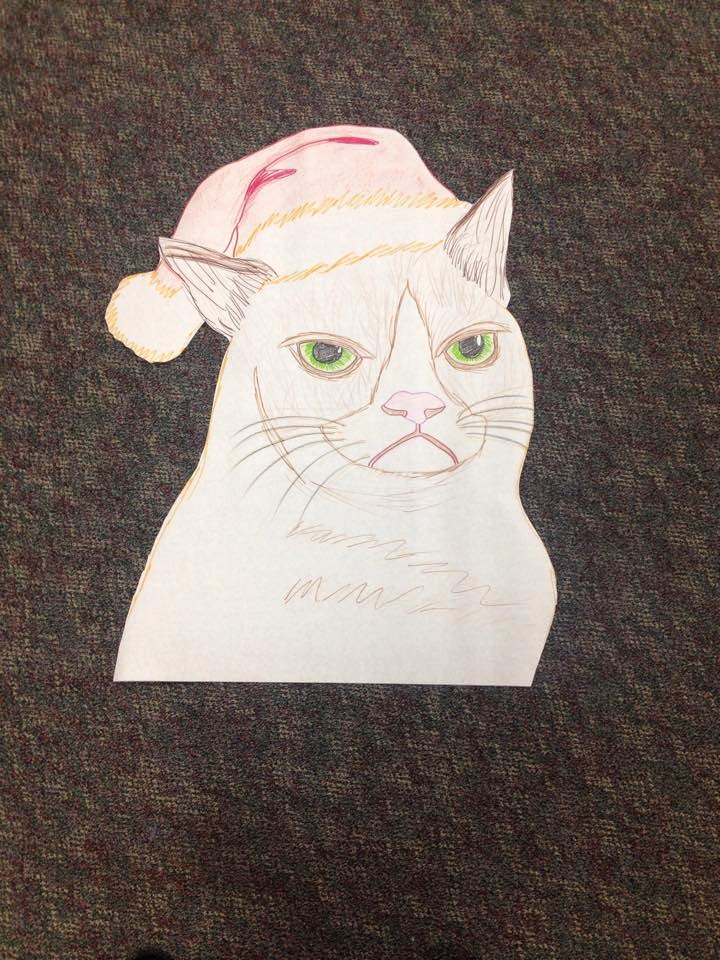
I use memes often in my classroom, so I just couldn't resist having a Grumpy Cat Christmas this year. I had already created a DiatonNOc scale board, so when it was announced that we would be doing a Christmas Door Decorating contest, I knew exactly what I would do.


This door was crazy easy to create. I projected a picture of Grumpy Cat onto some butcher paper, traced it, went over it in marker, and colored it in. Add in some Fa La La’s and extra Christmas decorative stuff, and you've got a hilarious door!


The final product!

My favorite part is seeing the kids’ faces when they see it. Priceless! It’s even enough to make me feel a little less grumpy when kids lose their minds this close to break.

Friday, December 5, 2014

Nutcracker Scarf and Wand Dances


I love December: Nutcracker time! My kids love it, and so do I. Every grade has a least one Nutcracker class every year, but primary grades focus on it the most. We focus on the story of the ballet first, and talk about the music. I focus on instruments and dynamics. Then we move on to dancing with scarves and wands.

Dance #1: Trepak
Ah, the good old Russian Dance. I love this one because it tires kids out. Perfect for a day (or a string of days) with indoor recess! Students are given 2 scarves, though 1 scarf will still work if your scarves are in short supply.

This dance is very simple. This is a good dance to practice with hands before you throw in the whole body, since the scarves are basically doing the same thing as your feet. For the A, we jump while we have our scarves go up and down. Then we kick while doing a similar motion with the scarves. For the B, we pulse our hands to the beat while we make a big circle in the air with the scarves. First we go clockwise, then counter-clockwise. For the bridge, we freeze on the strong beats. Below is the visual I use with the kids.


Dance #2: Chinese Dance
I love all three of these dances, but this is the one that is most likely to make me laugh out loud. This song has two basic phrases, so there are two basic movements: Frozen and swirling the scarves downward until you have your hands at your sides (think penguin walk) and tip-toeing around the room.


Dance #3: Dance of the Sugar Plum Fairy
I love this song, and it is so iconic. But how do you get boys to dance to a “girly” song about a fairy? Tinsel wands, my friends. That’s how. I’m fairly sure they would be willing to walk around in sparkly pink toe shoes if it meant they got a tinsel wand. The wands are also easy to make: get a bunch of recorder cleaners that usually end up unused anyway, tie some long tinsel to the end, and cover it with tape. I covered quite a bit of mine, so students would know they shouldn't touch the wand above the tape line. I was worried at first that they wouldn't last long, but I still have wands from five years ago!

For this dance, students are put into two groups: the sneakers and the magical ones. The sneakers have scarves and the magical ones have tinsel wands. They take turns freezing while the other one gets to move.


When we are done, I always have kids fold their own scarves. Below is the echo song I use as we fold our scarves. (If you don’t want to have to use an echo song, you could always have them fold as you play March of the Soldiers instead.)

Tuesday, December 2, 2014

Using Memes in Music Class


This year, I am mentoring four new music teachers in my district. When asked what my favorite trick for teaching hard concepts was, my immediate reply was, “Memes!” That may seem strange, but I swear these things are magic. A few years ago, a class was really struggling with the concept of DS Al Coda. We tried stories. We made up a rhyme. We looked at visual examples, audio examples, visual AND audio examples… nothing stuck. I made a silly meme (Grumpy Cat, I believe), suddenly every kid got the check-in questions right, and I got a new tool in my toolbox.

 '
Bah humbug for the holidays! 

I love posting memes outside my door. If a class is early, the kids will find memes they like and talk about them. Some are rather silly, but others tie directly to concepts I will be teaching. I also went a little meme-crazy for my holiday board this year. No regrets. I highly encourage any opportunity for students to think about musical concepts, even if they are just giggling at an unfortunate T-rex as they walk by.

The first meme is mine, the second is from here. There is a PTP posting, too.


At the beginning of the year, I used memes to help explain the rules. Kids were more willing to deal with procedures when Spongebob and Grumpy Cat were involved. I have two rules: Respect and Participate. Both were explained using the memes above. 


Piano and Forte cat are always helpful!

I like to use memes to introduce concepts. It’s a good hook, and provides a visual aid you can bring up later if you need to. I have my favorite memes in a Pinterest board and use them all the time.

Are you're kids struggling with slur vs. tie? NOT ANYMORE.


Memes can also help to serve as review. I have review questions for my older kiddos as they come in. Posting a meme or a comic and asking the kids to explain the joke is an easy way to review a concept while getting students to use academic language. 


Yup. Spongebob memes galore. 

I have a Pinterest board of my favorite memes here, and use them constantly. I hope you can find one that will help a concept stick for your kids! Happy meme-ing!