
Anyone who
knows me also knows I am a huge fan of children’s literature in the music
classroom. I use it constantly. To that end, about once a year I go to every
thrift store in town and raid the children’s book sections. I get some funny
looks, but I find great books! Here’s my haul from this week’s thrift store
adventure. I’ll include a brief description of the book, an Amazon link if you
want to check it out, and how I think it could be used in the classroom. (You can find the first book haul of the summer here.)

This is an
adorable book about a cowboy who is naturally LOUD and finds that there is a
time to holler and a time to hush. This lends itself well to loud/quiet and
piano/forte, and could easily transition to crescendo and decrescendo. It could
also be a fun way to introduce fortissimo.

This
sublimely simple book is full of prepositions as you follow elephants in a
hot-air balloon on their way to see their aunt. The art is beautiful as well.
This book would make a great tone bar exploration activity, so students can
explore what “above,” “below,” and “through” might sound like.

This fun
book is part of the Pete the Cat series. It focuses on verbs and their
appropriate locations (like eating in the cafeteria). This opens it up to be a
fun locomotor movement activity. Where could you slither? If you were in gym
class, what is a movement you could be doing?
Bear AboutTown, by Stella Blackstone

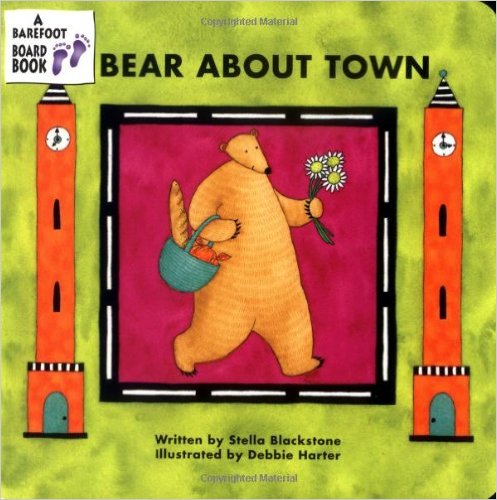
A book
focusing on the days of the week, Bear About Town opens with, “Bear goes to
town every day. He likes to walk all the way.” Each day has a new activity Bear
does. The opening sentences could easily be a refrain, and the various activities
could tie to a song or be group compositions. There is also a map of Bear’s
town in the book, which could be used to extend the activity.

Where’s
Spot? tells a story every parent is familiar with: looking for their kid. Each
page has a hiding place for Spot to be, and a flap to open to reveal if Spot is
there. This could be a great book for kids to play a “drum roll” as a way to
explore drums (or any new percussion instrument, really.) Kids love to play
fast, and this would give them a productive way to do that so later we can move
on.

Poor Harry
is a frog who just wants a meal, but every critter he encounters can’t be eaten
for one reason or another. Different animals could be represented by different
instruments. “You can’t eat me!” could become a sung refrain.

A classic! I
want to do an Eric Carle unit with my kinders, and this fits right in. All
students could play their instrument to match the number of items the
caterpillar is eating, or students could be split up into each food. (With the
green leaf counting as only one, there are 16 kinds of items, 26 total, on the
caterpillar’s menu.)

This is a
great book. Frog and his friends jam out with different movements, and the book
is very rhythmic. There are great opportunities for refrains, too.

I am
collecting any primary poetry book I can get my hands on, and this one is
pirate-themed. I would really like to use these for a group project to close
out a unit. Students could use instruments to show sound effects that go with a
poem, use the words as a basis for a pentatonic melody, transcribe the rhythm
into notation, or create an ostinato to go with the poem. I don’t have it
completely worked out yet, but collections of poetry like this one open a lot
of very cool doors.

Similar to
my intentions for the primary poetry, this collection of short fables could be
used for a group project. This would allow older students opportunities to add
musical elements to a story. My intermediate kids have extensive experience
with me dictating how a story could be made musical, and I would really like to
see what they would come up with when given the opportunity to make their own
choices. A whole-class version of the project could be used when short weeks
prevent you from getting to see more than one or two of your groups.
Summer is flying by, so I hope you find some great materials for your classroom!
Summer is flying by, so I hope you find some great materials for your classroom!


